Showing posts with label Mighty Ships. Show all posts
Friday, October 25, 2013
World's Largest research vessel

-Ronald H.Brown-

The National Oceanic and Atmospheric Administration (NOAA)Ship Ronald H.Brown, a state-of-the-art oceanographic and atmospheric research platform, is the largest vessel in the NOAA fleet. 

With its highly advanced instruments and sensors, Ronald H.Brown travels worldwide supporting scientific studies to increase our understanding of the world's oceans and climate.

Commissioned on July 19, 1997 in its home port of Charleston, South Carolina, Ronald H.Brown has sailed in the Pacific, Atlantic, and Indian Oceans. 


Ronald H.Brown is owned by the United States of America, Department of Commerce's National Oceanic and Atmospheric Administration. The ship is operated by NOAA's Office of Marine and Aviation Operations. 


Characteristics -
Length     83.5 m   
Beam       16.0 m
Draft        5.2 m
Displacement (Tons) 3,250   
Shaft Horsepower     3,000 hp


Wednesday, October 16, 2013
World's Largest Dredger

Cristobal Colon, which forms a part of the huge vessel fleet of the Belgian shipping infrastructure conglomerate Jan De Nul, is the largest and the most high-tech dredger in the world today.


Dredger under the trailer hopper class, the Cristobal Colon ship has catapulted the company as the premier dredging ship builders in terms of dredging. Also, owing to its massive capacity and several other salient features, the Colon is currently rated as the top class dredging ship.

Features
  • The most important requirement in any hopper vessel used in the dredging operation is the capacity of its hoppers. The Cristobal Colon ship has a hopper capacity of 46000 square metres.
  • In addition to the hopper capability, the largest ship has a very high dredging depth of 155 metres. Reaching such a depth is possible because of its technologically powered dredging pumps which are submerged beneath the water surface. These pumps are operated electrically and provide a power of 6,500 kilowatts each (kW)
  • There are two pipes which provide suction for the dredger and which measure 1,300 millimetres in diameter while the pumps to discharge the collected deposits are also operated electrically with a power of 8000 kW each
  • The pipes to carry out the suction can be altered or customised to dredge deposits at three various depths. This facility gives the Cristobal Colon the feasibility to carry out the dredging operation irrespective of the level of deposits in the water
  • The material used to build this largest ship is steel as it is non-corrosive in nature and offers a lightweight movement in the water, enabling the ship to carry out its operations without any problems.

Specifications
  • The Cristobal Colon measures 223 metres lengthwise, 41 metres breadth wise and has a draught of 15.15 metres
  • It offers a deadweight tonnage of 78,000 tons and has a speed of 18 knots
  • In terms of the accommodation facilities offered, the Cristobal Colon ship can accommodate 46 people


 Source-Marine insight

Saturday, October 12, 2013
Largest pipelaying vessel in the world

-Solitaire-   

Solitaire  is the largest pipelaying vessel in the world and has set new standards in the pipelay industry. Operational since 1998 and optimised for laying medium and large diameter pipelines at high speed, she is highly competitive for pipelay projects anywhere in the world.
Precise manoeuvring on full dynamic positioning (DP) allows Solitaire  to work safely in congested areas and lay pipes in very deep water. Pipeline start-ups and lay-downs are executed in very quick time ensuring that any disruption to other activities near platforms is minimised.
Based on the same principles as Lorelay, the long length and ship-shape allow Solitaire  to accommodate multiple work stations and a greater pipe carrying (22,000 t). This makes her much less dependent on offshore pipe supply in hostile areas and ensures excellent workability.
Solitaire  has achieved pipelay speeds in excess of 9 km/day, operating the latest version of Phoenix, the automatic welding system developed and manufactured in-house by Allseas. As a result of the large number of welding stations on board, Solitaire  is capable of installing over 1,000 km of pipeline in a single year, while her average pipelaying speed on large projects is almost double that of the largest competing lay vessels.

Solitaire  has laid numerous deep water pipelines.In 2007 she set the world record for ultra-deepwater pipeline installation by laying pipe at a depth of 2,775 m (9,100 ft). 

Solitaire's high cruising speed, high laying speed and substantial carrying capacity make Solitaire  highly competitive for pipelay projects anywhere in the world.


Characteristics-
    Length overall (incl. stinger)  -  397 m (1,302 ft)
    Length overall (excl. stinger)  -  300 m (984 ft)
    Length between perpendiculars - 249 m (817 ft)
    Breadth - 41 m (135 ft)
    Maximum speed - 13.5 knots
    Accommodation - 420 persons
    Total installed power - 51,480 kW
    

Deck cranes 
Two pipe transfer cranes
Special purpose crane

Pipe hold capacity 22,000 t


Source -Allseas.com
Saturday, October 5, 2013
World's Largest Livestock carrier

-MV Ocean Drover-  

The MV Ocean Drover (formerly the MV Becrux), was commissioned in 2002 and is the world’s largest, purpose-built livestock carrier, with advanced ventilation, feed and water systems.

The vessel is capable of transporting 75,000 sheep or 18,000 cattle to major markets around the globe.The vessel celebrated its 100th voyage in June 2010.
 

Vessel specifications - MV Ocean Drover

    Length: 180 metres
    Breadth: 31.1 metres
    Gross tonnage: 33.774,14 tonnes
    Livestock area: 24,000 sq metres
    Number of decks: 9
    Summer draft: 8.2 metres
    Fresh water capacity: 2, 740,000 litres
    Fresh water production: 600 tonnes per day from 4 reverse osmosis desalination plants
    Fodder Capacity: 1500 tonnes
    Air circulation: 60 air changes/hour
    Speed: 20 knots    Engines: Man B. & W. 7S50MC-C
    Crew: 45


Source-Wellard group website
Monday, September 30, 2013
Largest Heavy Lift carrier in the world

-Dockwise Vanguard-

Dockwise Vanguard is a semi-submersible heavy transport vessel (SSHTV) built by Hyundai Heavy Industries (HHI) in Ulsan for the Dutch shipping company Dockwise. Dockwise Vanguard is the largest heavy lift vessel in the world.
In February 2011, HHI was contracted to build a new ultra-large transport vessel for Dockwise. The vessel was launched in November 2012 and was delivered in February 2013. 


Dockwise Vanguard features a bow-less design developed by Dockwise and Delta Marine. The crew accommodation, including the lifeboats section, is on the starboard side of the vessel.
 

The design allows the flow of water along the entire deck, but prevents the entry of water into the enclosures of the vessel.

The ship is equipped with movable casing. A bulwark is also incorporated into the design to ensure the safety of the crew. Machinery exhausts are based on the towers at the port and starboard sides at the stern.
Dockwise Vanguard has an overall length of 275m, moulded breadth of 70m, depth of 15.5m and a submerged draft of 31.5m. The deadweight of the vessel is 117,000t.  


The ship is provided with a free deck space of 275 x 70m. The loading deck extends the entire length of the vessel.

The ship was classified with a heavy lift vessel notation and categorised as a 'Type 0' vessel. The semi-submersible heavy lift ship can be ballasted down to allow the cargo to be floated aboard. The ballast tanks are then de-ballasted to raise the deck over the water surface for lifting its cargo. 


Dockwise Vanguard can transport large FPSO vessels, drilling rigs or heavy platforms.


A graphical image of Dockwise Vanguard transporting an offshore platform. Image courtesy of Dockwise Ltd.

                                                                                                              Source-ship-technology.com
Friday, September 27, 2013
Largest Reefer in the world

-Cap San class-

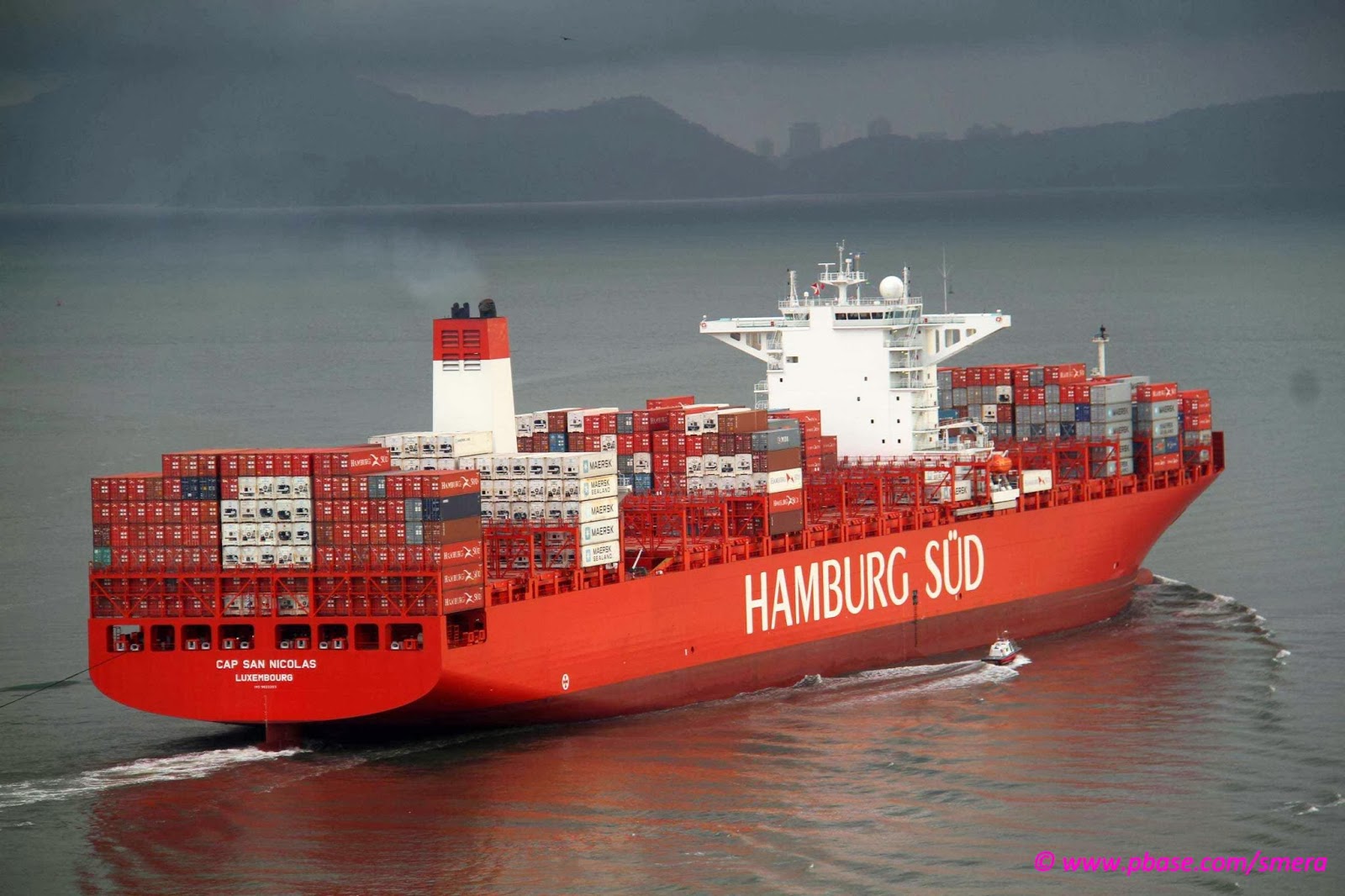
With a nominal slot capacity of 9,600TEU and 2,100 reefer plugs apiece, the Cap San Nicholas and Cap San Marco have taken their place as the largest container vessels ever launched by German-headquartered carrier Hamburg Sud, with the highest reefer carrying capacity of any container ship afloat today. 

Built at the Hyundai Heavy Industries yard in Ulsan, South Korea,  the two new ships were launched in late May as part of a series of six new-buildings in the Cap San class.  

The Cap San Nicholas will go into service this month on liner operations between Asia and the East Coast of South America, with the Cap San Marco entering the same service in July. Two more of the six new ships are due to be delivered this year, with the final two scheduled for handover in 2014.
 

The container ships are the first of a series of six new-buildings of the new “Cap San” class.

Two more “Cap San” ships will be delivered at the Korean yard in the current year. The last two units of this series are then due to be handed over to Hamburg Süd in January 2014.

Technical data of the “Cap San Nicolas” and “Cap San Marco”:

    Capacity: 124,500 tdw
    Slot capacity:  9,600 TEU
    Reefer plugs:  2,100
    Length overall:  333.2 m
    Length between perpendiculars:  313.5 m
    Width:  48.2 m
    Draught max.:  14 m
    Speed:  21 kn
    Main engine output:  40,670 kW


Cap San Nicolas
Cap San Marco
                                                                                                  Source-Hamburg sud official web site
Saturday, September 21, 2013
World's Largest Car carrier

-MV Tønsberg-

Wilhelmsen group made maritime history with four of the world’s largest RoRo car carrier ships ever built. As a first of the series, launched earlier in 2011, the DNV class MV Tønsberg also represented a 150th anniversary vessel for the Norwegian RoRo specialist. 

The Mark V class vessel is the largest of its kind, with a length of 862 feet offering a cargo volume of 138 000 cubic metres over six fixed and three hoistable decks. 
To serve this demanding trade lane with the ultimate in flexibility, efficiency and dependability, the Mark V class stands alone as one of the most sophisticated RoRo vessels ever built in terms of high ramp capacity, deck strength and height.
 

Wilhelmsen has traditionally developed and built their new generation ships in Japan together with Mitsubishi Heavy, and in this case with the layout design from in-house naval architects Wilhelmsen Marine Consultants working in collaboration with Mitsubishi Heavy. 

One of the shipyard’s specific contributions,was the push for a six-blade propeller rather than a five-blade one, a decision that made the ship essentially vibration free.
 

The entire cargo hold of the Mark V is arranged for customers’ high and heavy cargo such as excavators, bulldozers, wheel loaders and harvesters
With a width of 12 metres and a safe working load of 505 tonnes, the vessel’s stern ramp offers customers the possibility of shipping larger units than they ever could before.

Main Deck 4 has an entrance clearance of 7.4 metres with 25 metres of width, which is also unprecedented for this kind of vessel.

By moving the bridge forward, cargo can even be loaded on the weather deck, which has ramp access from the deck below. Three decks can be hoisted by electric winches to provide maximum flexibility and utilisation.
 

In the engine room, an advanced turbo generator produces electricity from the waste exhaust heat.these initiatives help to cut emissions significantly.
 

The first of the Mark V series is the MV Tønsberg, with the red coloured hull designating its ownership by the Wilhelmsen fleet. 

The second of the Mark V series, which is also at the quayside in the Nagasaki dock, sports the Wallenius green.
MV Tonsberg


Wednesday, September 18, 2013
World's Largest Submarine

-Russian Typhoon class-

Typhoon-class submarines are the world’s largest. They are quieter than their predecessors, largely due to their enormous size and improvements in quieting techniques. Despite their size, they are also more maneuverable than their immediate predecessors.

The main body of the sub contains two “pressure hulls,” which lie parallel to each other and a third, which sits on top of them. This unique design increases the width and simplifies the internal arrangement of the sub.

As part of a cooperative arms reduction program with former Soviet states, most of the six submarines in the Typhoon class are scheduled for dismantling by 2003.

Length: Approx. 574 ft (175 m)

Beam: 75 ft (23 m)
Draft: 38 ft (12 m)
Displacement: 33,800 tons
Propulsion: 2 pressurized-water nuclear reactors, 2 propellers
Crew: 150

Armament: 6 torpedo tubes, 20 ballistic missiles
First Sub Commissioned: December 12, 1981
Maximum Speed: Approx. 27 knots (31 mph/50 kph)


Monday, September 16, 2013
largest sailing vessel still operating


-Club Med 2- 

The Club Med 2 is a five-masted, computer-controlled sailing ship owned and operated by Club Med and operated as a cruise ship.

General Characteristics
Tonnage:   14,983 Tons
Length:     194 m
Beam:        20 m
Draught:   5,09 m
Capacity:  386 passengers ( + 214 crew members)
Speed:       10–15 knots (19–28 km/h)

She combines the power of seven computer-operated sails with more traditional diesel-electric power, having four diesel generators that power two electric motors.
 

The Club Med 2 was launched in 1992 in Le Havre, France. Its sister ship the Club Med 1 was sold to Windstar Cruises and renamed msy Wind Surf in 1998.
 

The ship, one of the largest sailing cruise ships in the world, carrying up to 386 passengers with a crew of 214, sails the waters of the Mediterranean and Adriatic Sea in the summertime, and the Caribbean in the winter, finding its way into anchorages larger cruise ships cannot reach.


Thursday, September 12, 2013
Largest sailing vessel ever


-SS Great Eastern-

The world's largest sailing vessel was SS Great Eastern designed by Isambard Kingdom Brunel and built in 1858 on the Thames River, England. 
Iron sailing steam ship was intended for the passenger and cargo trade between England and Ceylon.
 

General Characteristics
Tonnage: 18,915 GT
Length:    211 m (692 ft)
Beam:      25 m (692 ft)
Capacity: 4,000 passengers
Speed:     14 knots (26 km/h)

SS Great Eastern was by far the largest ship ever built at the time of her 1858 launch, and had the capacity to carry 4,000 passengers around the world without refuelling.

She was so far ahead of contemporary commercial requirements, and industrial capabilities, that her length (nearly 700 feet) and tonnage would remain unmatched for four more decades.
Great Eastern was laid up at Milford Haven, Wales in 1874. In 1886 she steamed to Liverpool to become an exhibition ship. This prosaic, but profitable employment continued during visits to London and Scotland later in the year. 

Sold late in 1887, Great Eastern went back to Liverpool, where she was stripped and slowly broken up during 1888 and 1889.


Sunday, September 8, 2013
Largest Warship


-USS Enterprise-

World's largest warship is nuclear-powered aircraft carrier USS Enterprise, she is also world's first nuclear-powered aircraft carrier and the eighth United States naval vessel to bear the name.
 

General Characteristics
Displacement:  93,284 long tons (94,781 t) Full Load
Length:             342 m (1.123 ft)
Beam:               40.5 m (132.8 ft) (waterline); 78.4 m (257.2 ft) (extreme)
Draught:          12 m (39 ft)
Speed:              33.6 kn (38.7 mph; 62.2 km/h)

USS Enterprise has been built by Newport News Shipbuilding and Drydock Company and she is in commission since 25 November 1961.


At 342 m  (1,123 ft), she is the longest naval vessel in the world. Her 93,284 long tons (94,781 t) displacement ranks her as the 11th-heaviest supercarrier, after the 10 carriers of the Nimitz class.

Enterprise has a crew of some 4,600 people.
 

Enterprise is also the only aircraft carrier to house more than two nuclear reactors. This was due to the ready availability of a field-proven production design developed for nuclear submarines. She is the only carrier with four rudders, two more than other classes, and features a more cruiser-like hull.
 

She was originally scheduled for decommissioning in 2014 or 2015, depending on the life of her reactors and completion of her replacement, USS Gerald R. Ford. 

But the National Defence Authorization Act for Fiscal Year 2010 slated the ship's retirement for 2013, when she will have served for 51 consecutive years, longer than any other U.S. aircraft carrier.


Friday, September 6, 2013
World's Largest Ocean Liner

-RMS Queen Mary 2-

RMS Queen Mary 2 is a largest transatlantic ocean liner in the world. 
She is a successor of Cunard Line's Queen Elizabeth 2 and she is the first major ocean liner built since Queen Elizabeth 2 in 1969.

General Characteristics
Tonnage:  148,528 GT
Length:   345 m (1,132 ft)
Beam:   41 m (135 ft)
Draught:  10,10 m (33 ft)
Capacity: 2,620 passengers (+ 1,253 crew members)
Speed:   30 knots (56 km/h; 35 mph)

The ship was named the Queen Mary 2 by Queen Elizabeth II in 2004 after the first RMS Queen Mary, completed in 1936. 
The Queen Mary was in turn named after Mary of Teck, consort of King George V. With the retirement of Queen Elizabeth 2 from active duty in 2008, the Queen Mary 2 is currently the only transatlantic ocean liner in service running between Southampton and New York, although the ship is often used for cruising, including an annual world cruise.

The Queen Mary 2 was intended primarily to cross the Atlantic Ocean, and was therefore designed differently from many other passenger ships.


-Adopted from Maritime connector-

Wednesday, September 4, 2013
Largest LNG carrier

Q-Max ships are the world's largest membrane type liquefied natural gas carriers. 

General Characteristics
Tonnage:  162.400  GT
Length:    345 m (1,132 ft)
Beam:      53,80 m (177 ft)
Draught:  12 m (39 ft)
Capacity: 266,000 m3 (9,400,000 cu ft)
Speed:     19,5 knots
 

Fourteen Q-Max ships have been built: Mozah, Al Mayeda, Mekaines, Al Mafyar, Umm Slal, Bu Samra, Al-Ghuwairiya, Lijmiliya, Al Samriya, Al Dafna, Shagra, Zarga, Aamira and Rasheeda

They are all operated by Nakilat (Qatar Gas Transport Company) and they were built by three different builders: Samsung Heavy Industries, Hyundai Heavy Industries and Daewoo Shipbuilding & Marine Engineering. 

In their name Q-Max, "Q" stands for Qatar and "Max" for the maximum size of ship able to dock at the LNG terminals in Qatar.
 
-Adopted from Maritime connector-
Tuesday, September 3, 2013
Largest Cruise ship in the world

The world's largest cruise ships(and passenger ships in general) are Oasis of the Seas and Allure of the Seas. These ships belong to Royal Caribbean's Oasis class formerly known as Project Genesis.
 

General Characteristics
Tonnage: 225,282 GT
Length:    360 m (1,181 ft)
Beam:       47 m (154 ft) waterline; 60.5 m (198 ft) extreme
Draught:  9.3 m (31 ft)
Capacity: 5,400 passengers at double occupancy; 6,296 maximum (+ 2,394 crew members)
Speed:      22.6 knots (41.9 km/h; 26.0 mph)

Both ships were ordered in February 2006 at STX Europe shipyard in Turku, Finland.

First in a series, Oasis of the Seas, was completed and turned over to Royal Caribbean on 28 October 2009. Her sistership, Allure of the Seas, left the Turku shipyard on 29 October 2010.
Althought those two ships have identical superstructures, the Allure is 50 millimetres (2.0 in) longer than the Oasis, which is making her technically the largest cruise ship in the world.
Oasis of the seas

Allure of the seas
-Adopted from Maritime connector-
Sunday, September 1, 2013
World's Largest Bulk carrier

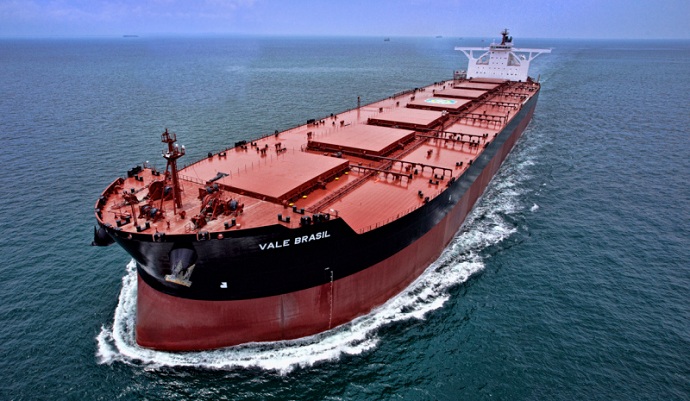
MS Vale Brasil is the largest bulk carrier ever built and among the longest ships currently in service. 
She is a "member" of Valemax fleet chartered by the Brazilian ore giant Companhia Vale do Rio Doce (VALE) to carry iron ore from Brazil to European and Asian ports.
 

General Characteristics
Tonnage: 198,980 GT (67,993 NT)
Length:    362.0 m (1,187,7 ft)
Beam:      65.0 m (213.3 ft)
Draught:  23.0 m (75,5 ft)
Capacity: 402,347 DWT
Speed:     15.4 knots (28.5 km/h; 17.7 mph)

MS Vale Brasil is the first of seven 400,000-ton very large ore carriers (VLOC) ordered by Vale and she was launched in December 2010.
MS Vale Brasil is significantly larger than the previous world's largest bulk carrier Berge Stahl in every aspect. 

Both her gross tonnage and deadweight tonnage are larger than those of the Norwegian ship, 175,720 and 364,767 tons, respectively. 
While the draught of both ships is the same, Vale Brasil is also 20 metres (65.6 ft) longer and 1.5 metres (4.9 ft) wider than Berge Stahl. 
Additionally Vale Brasil is larger and slightly longer than the four new 388,000-ton, 361-metre (1,184 ft) China-max bulk carriers Berge Bulk has ordered from China Shipbuilding Industry Corporation.
MS Vale Brasil is also the second largest ship currently in service by deadweight tonnage, second only to the TI class supertankers that have a deadweight tonnage of over 440,000 tons.


-Adopted from maritime connector-
Friday, August 30, 2013
Largest Oil tankers still operating


-TI class supertanker-


The largest oil tankers currently operating are the TI Class supertankers built in 2002/3.


General Characteristics
Tonnage:     234,006 GT (162,477 NT)
Length:     380 m (1,250 ft)
Beam:     68 m (223 ft)
Draught:     24.525 m (80.46 ft)
Capacity:     441,585 DWT, 3,166,353 barrels (503,409,900 l)
Speed:     16.5 knots laden, 17.5 knots in ballast

The class comprises from the following ships: TI Africa, TI Asia, TI Europe and TI Oceania, where the "TI" refers to the VLCC Tanker Pool operator Tankers International L.L.C.
 

TI Africa

TI Asia

TI Europa

TI Oceania
-Adopted from Maritime connector-
Saturday, August 24, 2013
Largest Oil Tanker ever

Seawise Giant (1979–1989), later named Happy Giant (1989–1991), Jahre Viking (1991–2004), Knock Nevis (2004–2009) and Mont (2009–2010) was a ULCC supertanker and the longest ship mankind ever built, and possessed the greatest deadweight tonnage ever recorded. 

Fully laden, her displacement was 657,019 tonnes (646,642 long tons, 724,239 short tons), the heaviest ship of any kind, and with a draft of 24.6 m (81 ft), she was incapable of navigating the English Channel, the Suez Canal or the Panama Canal.

She could reach up to 16.5 knots (30.6 km/h) in good weather, it took 5.5 miles (8.9 km) to stop from that speed, and the turning circle in clear weather was about 2 miles (3.2 km)
Overall, she was generally considered the largest ship ever built, as well as the largest self-propelled, man made object ever built. 


Tonnage:     260,941 GT (214,793 NT)
Length:     458.45 m (1,504.10 ft)
Beam:     68.8 m (225.72 ft)
Draught:     24.611 m (80.74 ft)
Capacity:     564,763 DWT
Speed:     16 knots (30 km/h; 18 mph)
 

Built in 1979 by Sumitomo Heavy Industries,Ltd. at their shipyard in Japan. 

During the Iran-Iraq War it was damaged by an air force attack in the Strait of Hormuz on 14 May 1988. 
She was sank and was considered completely lost. However the wreckage was salvaged and repaired. After the repairs she was back in service as Happy Giant. 
In 1991 she was bought by the Norwegian Jorgen Jahre and renamed into Jahre Viking.

She was last used as a floating storage and offloading unit (FSO) moored off the coast of Qatar in the Persian Gulf at the Al Shaheen Oil Field.
 

The vessel was sold to Indian ship breakers, and renamed Mont for her final journey in December 2009. After clearing Indian customs, she was sailed to, and intentionally beached at Alang, Gujarat, India for demolition.


-Adopted from Maritime connector-
Friday, August 23, 2013
The Largest container ship in the world

-MV Maersk Mc-Kinney Moller-

The sea giant: MV Maersk Mc-Kinney Moller is the world's largest container ship.

The Danish oil and shipping group, A.P. Moller-Maersk is the parent company of the world's largest container, MV Maersk Mc-Kinney Moller, named after the son of the company's founder.

The vessel, that was built by the South Korean Daewoo Shipbuilding & Marine Engineering shipyard, has a cargo capacity of 18,270 containers, the largest of any ship yet constructed.

The 55,000 tonne ship, has a length of 400 meters.

The ship carries the first Triple-E Standard (Economy of Scale, Energy Efficiency, Environmentally-improved) and is the most efficient and energy saving container ship in the world.

The ship is capable of delivering more goods than ever, while using less fuel consumption and lower CO2 emissions.

- Adopted from The Economic Times-